Define the experience
Write application behavior around the prompts, content, and supported capabilities your activity needs.
HumanFrame Framework
One evolving framework for bringing applications, robot capabilities, and research ideas together.
A useful robot needs a system that lets new ideas run on it. HumanFrame connects application development, on-robot execution, and deployment as parts of the same engineering effort.
The intended architecture gives each layer a clear responsibility.
HumanFrame Platform supports application packaging, deployment, and monitoring around this workflow.
A system overview, rather than a claim that every interface is complete. Prototype foundations exist; integration and supported capabilities are expanding.
Clear responsibilities
Researchers should be able to concentrate on application behavior without recreating every connection to the robot.
A developer's path
The goal is a consistent route from a research idea to an application running on a physical robot.
Write application behavior around the prompts, content, and supported capabilities your activity needs.
Package compatible code and resources, then validate the application before installation.
Use the runtime to execute the application and connect it with supported hardware functions.
Review execution information and logs to guide the next application revision.
Local application packaging, installation, execution, and health checks have been demonstrated in development prototypes. The complete web-to-robot experience is still being integrated.
Systems engineering for interaction
Coordinating audio, visual feedback, application behavior, and physical hardware takes careful integration. Our framework is being built as a shared foundation for that work.
Current development builds on tested camera and audio capture, runtime execution, and local deployment prototypes. Integrated conversation, expressive displays, wider application interfaces, and planned mobility require further development and validation.
See capability status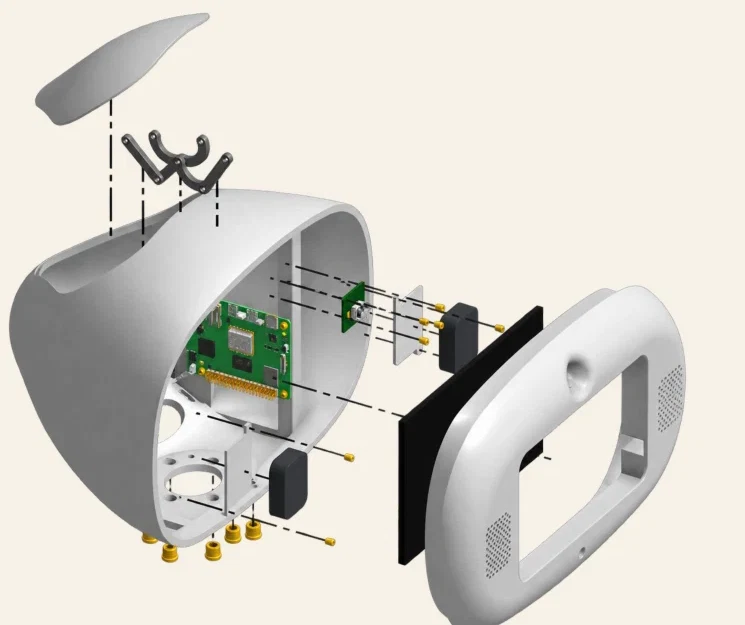
Explore potential research uses, or talk with us about the software capabilities your work would need.